Hair fall is not a single problem. Treating it like one is why most treatments fail. Hair fall is often discussed casually: oil more, stress less, take supplements, and wait six months. But people who sit in front of a mirror every morning and see more scalp than yesterday know this is not casual. Hair fall is controlled by biology, timing, and decisions taken early or delayed too long.
At Dr. Paul’s Advanced Hair & Skin Solutions, hair fall treatment is approached with one basic understanding: that is, hair does not fall randomly, and it does not recover randomly either.
This blog is not about quick fixes. It explains how hair loss actually progresses, why many treatments do not work, and how medical hair care should be planned.
Most patients come saying, “My hair is suddenly falling.” But, in reality, hair fall starts months before it becomes visible. The hair cycle works in phases:
When something disturbs this cycle, such as hormonal change, nutritional gap, inflammation, or genetic sensitivity, the hair enters shedding mode earlier than it should. What you see today actually started weeks or months back. This is why waiting and watching rarely helps.
External products can improve scalp comfort, hair texture, and breakage control. But they cannot correct internal triggers like:
This is not a criticism of products. It is a reality of hair biology. Hair loss treatment must address what is happening below the skin, not only on it.
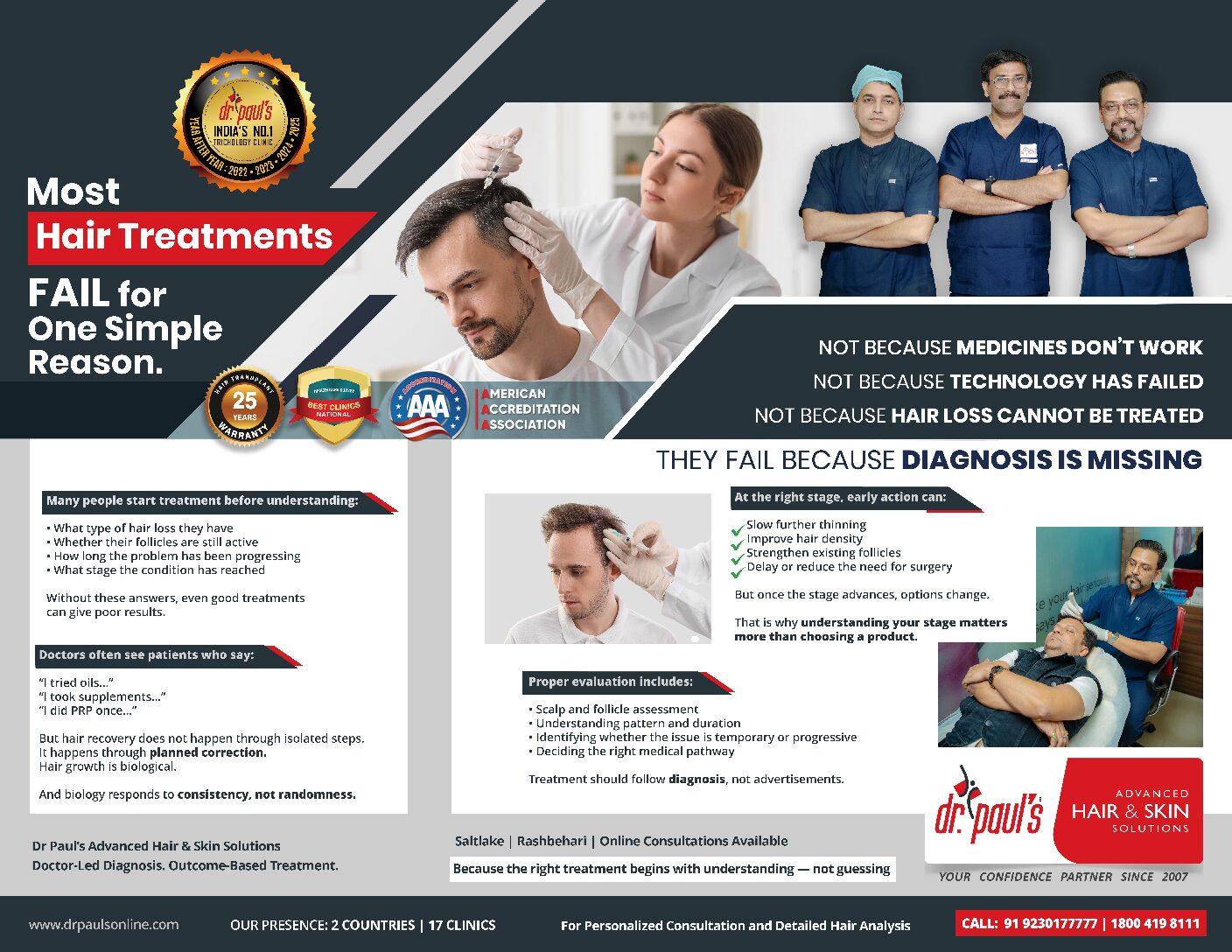
Treating all hair fall with the same protocol is a mistake. At Dr. Paul’s Advanced Hair & Skin Solutions, hair loss is broadly evaluated into patterns such as:
Each pattern behaves differently; some are reversible, some are controllable, and some are progressive by nature. Using the same protocol for all of them creates false hope and wasted time.
Correct identification of the pattern decides whether the goal is recovery, preservation, or long-term control.
This is a common frustration. Patients say:
This happens when:
Hair follicles are living structures. They respond, adapt, weaken, or recover depending on conditions. Treatment cannot remain static while biology keeps changing. Hair fall management requires review, modification, and timing, not blind continuation.
Before starting any treatment, clarity is established. Evaluation includes:
This assessment answers an important question: Is the hair likely to recover, stabilise, or only slow down further loss? Not every patient needs aggressive treatment. Not every patient can afford to wait either.
For many patients, hair fall can be stabilised with:
These are not cosmetic recommendations. They are medical decisions, reviewed and adjusted based on response. The aim at this stage is control, not dramatic regrowth.
PRP works best when:
PRP does not create new follicles. It helps existing ones function better. Over-promising results here leads to disappointment. At Dr. Paul’s Advanced Hair & Skin Solutions, PRP is advised selectively, not routinely.
Mesotherapy delivers nutrients directly to the scalp, where absorption is otherwise poor. It is useful when:
It supports the scalp environment. It does not replace medical treatment. Used correctly, it complements the plan rather than becoming the plan.
Some hair loss patterns are progressive by nature. In such cases, treatment focuses on:
Honest guidance is given early so expectations remain realistic.
This is rarely discussed openly. Hair fall treatment cannot:
Clear boundaries protect patients from false hope and unnecessary expense.
Hair fall increases stress. Stress worsens hair fall. But treating stress alone does not reverse hair loss. Medical intervention breaks this cycle by stabilising shedding first. Once hair fall reduces, mental stress naturally improves. Ignoring hair fall and focusing only on “stress management” delays recovery.
Hair responds slowly. This is biological, not optional. General expectations:
Anyone promising visible regrowth in 30 days is not being honest.
Women often have:
Because shedding may not look dramatic, hair fall is often dismissed as temporary. By the time thinning becomes obvious, density is already compromised. Early evaluation matters more than aggressive treatment later.
Patients choose Dr. Paul’s Advanced Hair & Skin Solutions because:
Hair is treated as a long-term health concern, not a cosmetic emergency.
Hair fall is not solved by hope, oils, or shortcuts. It is managed by understanding timing, biology, and limits.
If you are considering hair fall treatment, the most important step is not speed but clarity. Knowing why your hair is falling, what stage it is in, and what can realistically be controlled makes all the difference. Hair that is assessed early can often be stabilised and preserved for years. Hair that is ignored, delayed, or treated casually usually reaches a point where options become limited.
Hair fall management is not about chasing quick results. It is about making the right decisions before the damage becomes permanent.
DR PAULS MULTISPECIALITY CLINIC PRIVATE LIMITED provides a unique and different approach.
Copyright © 2025. All Rights Reserved.